Every fixed-payment loan - a home loan, personal loan, car loan or education loan - is repaid using amortization: each payment is split between interest (charged on what you currently owe) and principal (which reduces what you owe). Early in the loan, most of each payment goes to interest, because the outstanding balance is largest then. As the balance shrinks, more of each payment goes to principal.
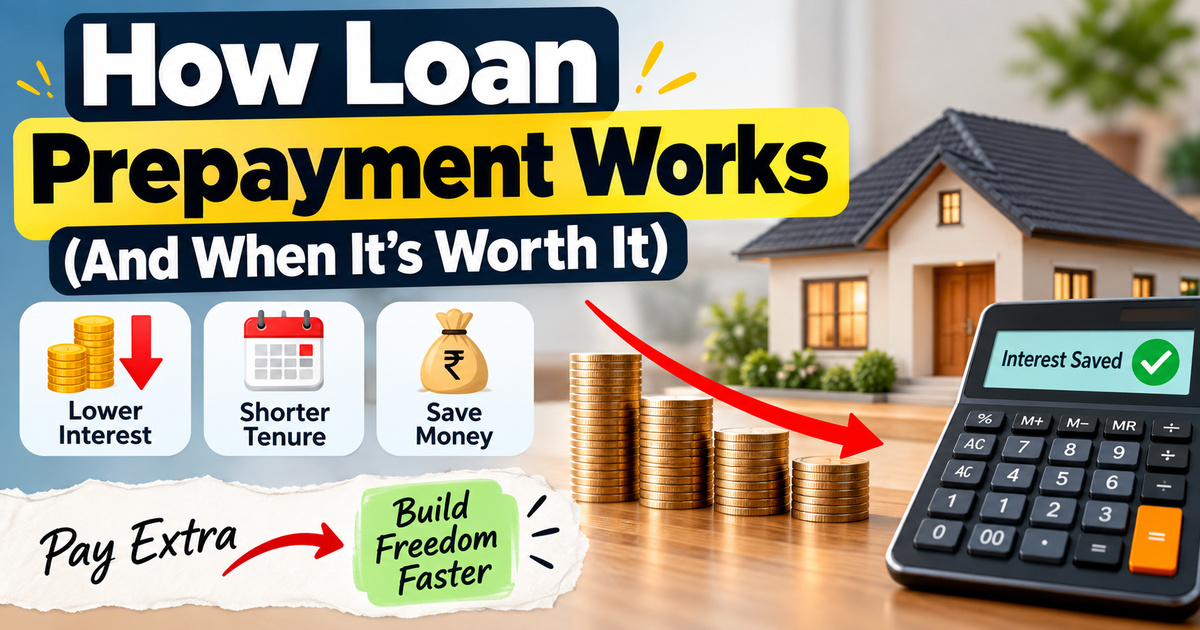
Prepayment - also called a part-payment, extra payment or overpayment depending on where you live - is any amount you pay beyond your scheduled payment. Because it's applied directly to your outstanding principal, it does two things immediately: it lowers the balance interest is calculated on for every payment that follows, and it moves you further along the amortization schedule than your payment count alone would suggest.
Why timing matters
A prepayment made in year 2 of a 20-year loan removes that amount from a balance that would otherwise have accrued interest for another 18 years. The same prepayment made in year 18 only saves 2 years of interest on that amount. This is why prepaying earlier in a loan's life generally produces a larger interest saving in absolute terms than the same amount prepaid later - the balance has more remaining time to "not" accrue interest on.
Part-payment vs full foreclosure
A part-payment is a prepayment that doesn't close the loan - you pay extra, but the loan continues at a reduced balance. A full foreclosure (or full prepayment) clears the entire outstanding balance at once and ends the loan immediately. Both work on the same principle - reducing the balance interest is charged on - foreclosure just does it completely in a single step. See our part-payment vs foreclosure comparison for how to decide between the two.
What actually changes after a prepayment
Most lenders let you choose one of two outcomes once you've made a part-payment:
- Keep the payment the same, shorten the tenure. Your EMI/payment amount doesn't change, but because the balance is lower, you finish paying it off in fewer remaining payments.
- Keep the tenure the same, reduce the payment. Your loan still ends on the original date, but each remaining payment is smaller because it's calculated against a lower balance.
Shortening the tenure while keeping the payment fixed generally saves more total interest, because the loan is paid off sooner. Reducing the payment instead eases your monthly cash flow but stretches out the same balance over more remaining payments, so it saves less interest overall. Neither is objectively "better" - it depends on whether your priority is minimising total interest or freeing up monthly cash flow. We cover this trade-off in detail in reduce EMI or reduce tenure after prepayment.
Key takeaways
- Prepayment reduces your outstanding balance immediately, which reduces the interest charged on every payment after it.
- Prepaying earlier in a loan's life generally saves more interest than the same amount prepaid later.
- You usually choose between a shorter tenure (more interest saved) or a lower payment (more monthly cash flow).
- Always confirm your lender doesn't charge a prepayment penalty that could outweigh the saving.
When prepayment is usually worth it
Prepaying tends to make sense when your loan's interest rate is higher than what you could reasonably earn (after tax) by investing the same money elsewhere, when your lender doesn't charge a prepayment penalty, and when you have a stable emergency fund already set aside - since prepayment reduces your loan balance but doesn't give you that money back on demand the way savings would.
It's less clear-cut when your loan carries a low interest rate, when prepaying would use up your entire liquid savings, or when your lender does charge a meaningful penalty. In those cases, run the numbers for your specific loan rather than assuming prepayment is automatically the right move.
See what a prepayment would save you
Enter your own loan details and get your new tenure, interest saved and closing date.
Frequently asked questions
Does prepaying a loan always save money?
In almost all cases yes, because it reduces the balance interest is charged on for the rest of the loan. The exception is if your lender charges a prepayment penalty that's larger than the interest you'd save - check your loan agreement first.
Is there a minimum amount I need to prepay?
It depends on the lender. Some allow any extra amount with each payment; others set a minimum part-payment amount or only allow prepayment on specific dates. Ask your lender directly.
Does prepayment affect my credit score?
Paying down debt faster is generally viewed positively over time, since it lowers your outstanding balance and credit utilisation. A single prepayment itself isn't reported as a special event - it just shows up as a lower balance.